
 Poker Rules & FAQ
Everything you need to know about Texas Hold'em
Basics
Texas Hold'em is the most popular poker variant in the world. Each player receives 2 face-down cards (Hole Cards), and 5 community cards are placed face-up on the table.
Goal: Make the best 5-card poker hand from 7 available cards.
Minimum: 2 players (Heads-Up)
Maximum: 10 players at one table
Optimal: 6–9 players for the best experience
Blinds are forced bets posted before cards are dealt.
Small Blind: Player to the left of the dealer posts half the minimum bet
Big Blind: Next player posts the full minimum bet
The Dealer Button (also called "the Button") marks the position of the theoretical dealer.
- Moves clockwise after each hand
- Determines blind positions
- The Button acts last in all betting rounds (best position!)
Gameplay
1. Pre-Flop: Each player receives 2 Hole Cards, first betting round
2. Flop: 3 community cards are revealed, second betting round
3. Turn: 4th community card is revealed, third betting round
4. River: 5th community card is revealed, final betting round
5. Showdown: Remaining players show their cards, best hand wins
Pre-Flop: Player to the left of the Big Blind (Under the Gun / UTG)
Flop, Turn, River: Player to the left of the Dealer Button (Small Blind position)
Important: Action always moves clockwise!
The showdown occurs when at least 2 players remain after the River betting round.
- The last aggressor (last bet/raise) shows their cards first
- Other players can show or muck (discard face-down)
- The best 5-card hand wins the pot
- Equal hands split the pot (Split Pot)
Hand Rankings
All poker hands from strongest to weakest:
| Rank | Hand | Description | Example | Probability |
|---|---|---|---|---|
| 1. | Royal Flush | The absolute best hand! | 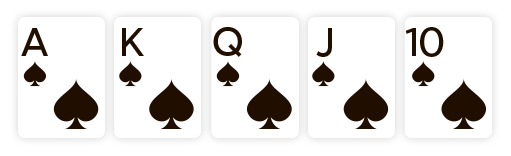 | 0.00015% |
| 2. | Straight Flush | 5 consecutive cards of the same suit | 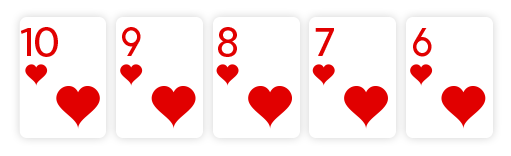 | 0.0014% |
| 3. | Four of a Kind | 4 cards of the same value | 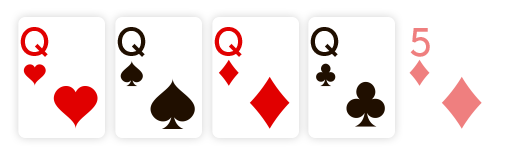 | 0.024% |
| 4. | Full House | Three of a kind + a pair | 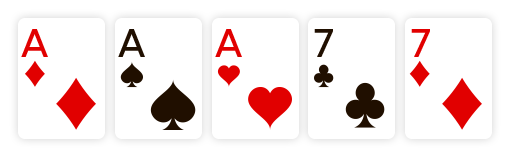 | 0.14% |
| 5. | Flush | 5 cards of the same suit | 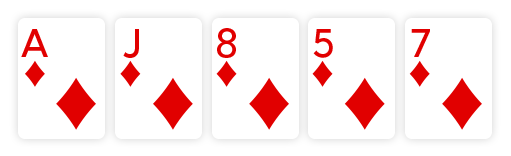 | 0.20% |
| 6. | Straight | 5 consecutive cards | 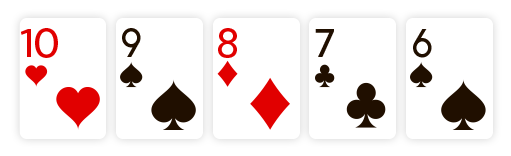 | 0.39% |
| 7. | Three of a Kind | 3 cards of the same value | 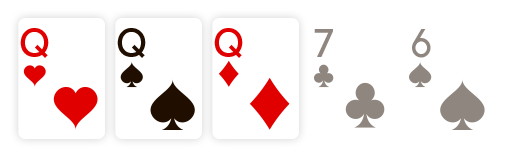 | 2.11% |
| 8. | Two Pair | 2 different pairs | 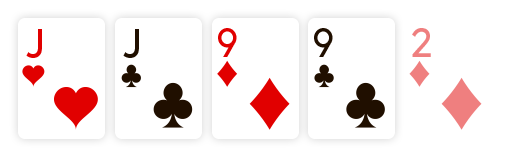 | 4.75% |
| 9. | One Pair | 2 cards of the same value | 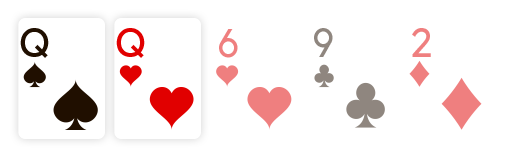 | 42.26% |
| 10. | High Card | None of the above combinations | 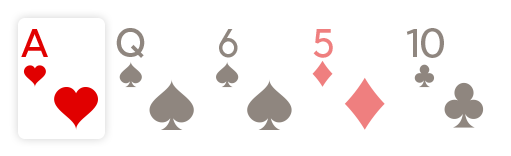 | 50.12% |
Over the years many nicknames for poker hands have been invented:
- Big Slick: A-K (best non-paired hand)
- Pocket Rockets: Pocket Aces (AA)
- Cowboys: Pocket Kings (KK)
- The Ladies: Pocket Queens (QQ)
- Fish Hooks: Pocket Jacks (JJ)
- TNT: Pocket Tens (TT)
- Two Snowmen: Pocket Eights (88)
- Doyle Brunson: 10-2 (won 2x WSOP Main Event with it)
- Dead Man's Hand: A-8 (Wild Bill's last hand)
- Kojak: K-J
- Maverick: Q-J
- Valentines: K♥-Q♥
- Phil Hellmuth: Black Nines (99♠♣)
Betting & Actions
Check: Pass without betting (only if no bet in front of you)
Bet: Place the first bet in a round
Call: Match the current bet
Raise: Increase the current bet
Fold: Discard your hand and exit the round
All-In: Put all your remaining chips into the pot
The minimum raise must be at least as large as the previous bet or raise in the same round.
A C-Bet is a bet on the flop by the player who raised pre-flop — regardless of whether they hit the flop.
- Shows strength and puts pressure on opponents
- Typical size: 50–75% of the pot
- Common: used in ~60–70% of situations
Advanced
Pot odds compare the current pot size to the cost of a call — helping you decide whether a call is mathematically profitable.
Pot: 100 chips | Call: 25 chips
Pot Odds: 100:25 = 4:1 = 20%
If your win probability is above 20%, calling is profitable!
Position refers to your seat relative to the Dealer Button.
Positions (9-handed):
- Early Position: UTG, UTG+1, UTG+2
- Middle Position: MP1, MP2, MP3
- Late Position: Cutoff, Button
- Blinds: Small Blind, Big Blind
Why is late position better?
- You see what everyone else does before deciding
- More information = better decisions
- Can play more hands profitably
- Better bluffing opportunities
Outs are cards that improve your hand and are likely to lead to a win.
Your hand: A♠ K♠
Flop: Q♠ 8♠ 3♥
Outs: 9 spade cards remain in the deck
Win chance on Turn: ~19%
Win chance to River: ~35%
Flop → Turn: Outs × 2 = approximate %
Flop → River: Outs × 4 = approximate %
A side pot is created when a player goes all-in but other players have more chips.
Player A: 1,000 chips (goes All-In)
Player B: 5,000 chips (calls)
Player C: 5,000 chips (calls)
Main Pot: 3,000 (1,000 from each)
Side Pot: Additional bets between B and C
Important: Player A can only win the Main Pot!
Tournament Rules
Cash Game:
- Blinds remain constant
- Chips = real money
- Can leave and cash out at any time
- Can buy more chips (Re-Buy)
Tournament:
- Blinds increase at set intervals
- Chips = tournament value (not direct cash equivalent)
- Play until eliminated or victorious
- Usually no Re-Buy (except in Re-Buy phase)
- Prize money distributed by finishing position
In tournaments blinds increase after set time intervals (levels).
Level 1 (0–15 min): 25/50
Level 2 (15–30 min): 50/100
Level 3 (30–45 min): 75/150
Level 4 (45–60 min): 100/200
...and so on
Ante:
- From a certain level all players post a small forced bet
- Increases the pot and forces more action
- Typically from level 3–5
"In the Money" means you have advanced far enough to win prize money.
Buy-In: €100
Prize Pool: €10,000
Paid Places: Top 15 (15% of players)
Place 16: "Bubble" – just missed out!
Place 15: ITM – Min-Cash (e.g. €150)
Place 1: €3,000
ICM is a mathematical model that calculates the current real-money value of your tournament chips.
Why does it matter?
- Tournament chips ≠ cash game chips
- Winning chips is worth less than losing chips costs
- Especially relevant at the bubble and final table
Satellite tournaments are qualifying tournaments where you can win tickets to larger events.
Satellite Buy-In: €10
Target Event Buy-In: €100
100 players: Top 10 win a ticket
No prize money, only tickets!
Strategic differences:
- Survival is more important than chip accumulation
- Place 10 = Place 1 (both get a ticket)
- Play very tight when close to a ticket
General Rules
For the Tournament Director and their representative, fairness and the best solution in the interest of the game take the highest priority.
Situations not mentioned in these rules are decided by the management appropriately and taking the relevant circumstances into account.
Players are expected to:
- Confirm registration data and seat assignment
- Protect their cards
- State their intentions clearly
- Follow the game flow
- Act when it is their turn
- Defend their right to act
- Ensure their cards are visible
- Stack their chips properly
- Remain at the table during a hand
- Speak up when they notice a mistake
- Change tables promptly when asked
- Follow a hand
- Respect and follow the rules
- Generally contribute to a proper tournament flow
During the play of a pot only German or English may be spoken.
Simple, unambiguous, internationally recognised announcements must be used for all actions:
Active actions:
- bet
- raise
- call
- all-in (putting all chips in)
- raise pot (pot-limit variants only)
- complete
Passive actions:
- fold
- check
The use of mobile phones, tablets, laptops or other electronic devices during a hand is not permitted under any circumstances.
- For phone calls the player must leave the table
- Devices may be placed beside the table
- The game must not be held up or disturbed
- Chips and cards must be visible at all times
- A smooth game flow must be ensured
Deals are generally permitted in any tournament as long as they do not violate the game rules.
Rules:
- All deals are announced officially
- Deals must be made directly at the final table
- Players have a maximum of 10 minutes
- If no agreement is reached the tournament continues
- Participants should not leave the final table
- One support person is permitted
When continuing play after a deal:
- 10% of the remaining prize pool must be played out
- Deal calculation: ICM or Chip Chop
- Written agreement with signatures
A shot clock (time limit for a decision) may be used in certain phases of a tournament or throughout.
Speed up play and ensure a fair decision time.
The exact rules are set and published by tournament management.
The following variants apply in all TEXAS HOLD'EM and OMAHA games:
a) Double Board:
The dealer deals two boards, each consisting of a Flop, Turn and River. The pot is split equally between the two boards.
b) Flip:
Each player posts a set amount before the hand and the dealer deals the full board without a further betting round, going straight to showdown.
c) Bomb Pot:
Each player posts a set amount before the hand and the dealer deals the Flop without a further betting round. Play continues normally after the Flop.
Tournament management reserves the right to cancel a tournament or change the schedule at short notice.
Tournament Flow
No player wishing to re-buy may miss a hand.
Once "re-buy" is announced, the player is obligated to complete it.
Players who have already participated may re-enter the tournament.
- Duration is set by tournament management before the start
- Ends when the money positions are reached
- Players receive the full starting stack
In bounty tournaments where a bounty chip is used:
- The chip is only worth the bounty amount
- Posting a bounty chip does not count as All-In
- A posted bounty chip counts as a call or minimum bet
The card deck can be replaced at any time by tournament management or floor staff.
A hand is generally considered folded when:
- A player discards their cards face-down with a clear forward motion (even out of turn)
- The cards are intentionally opened independently before a possible active action
- The player touches already folded cards
- All side pots are settled separately
- Pots are not combined before splitting
- Important: Players must never touch the pot
After a reasonable time for a decision has passed and tournament management has been called:
- The player has one additional minute
- The last 10 seconds are counted down aloud
- Without a decision the hand is dead
- Penalty: Intentional delay of play is penalised
- Turbo tournaments: 30 seconds thinking time with a 5-second countdown
As blinds increase during a tournament, small denomination chips are no longer needed.
🎲 Chip Race:
Blinds are now 2,000/4,000. The 100-chips become useless.
You have: 3 × 100-chips = 300 chips
Problem: 300 cannot be exchanged evenly into 500-chips!
Solution – Chip Race:
- You receive 1 card per 100-chip (so 3 cards)
- The highest card(s) at the table win the new 500-chips
- You can win a maximum of 1 new 500-chip
- No player can be eliminated by Chip Race
🔄 Colour-up:
You have: 20 × 100-chips = 2,000 chips
Exchange: 4 × 500-chips = 2,000 chips
No problem! Exchanges evenly, no Chip Race needed.
This rule comes into effect before the money positions are reached.
Procedure:
- All tables complete one hand and pause
- Once all tables are done, the next hand is dealt
- Repeated until money positions are reached
a) All-in during Hand for Hand:
- Clock is stopped
- Players do not yet reveal their cards
- Wait until all other tables are done
- Showdown then takes place
b) Simultaneous elimination (different tables):
These players share the finishing position.
c) Simultaneous elimination (same table):
The player with the higher chip count at the start of the hand finishes higher.
- Seats are drawn randomly (like a Re-Draw)
- The Button position is redrawn
- A player may end up in the same position as before
- Final Table is started at tournament mode +1 (e.g. 6-handed becomes 7-handed)
- Maximum 9 seats
- The Button always has the Small Blind
- The Big Blind receives the first card
- Button must be positioned so no player has the Big Blind twice in a row
- Level duration is automatically halved
- Big Blind Ante is also used in heads-up
The right to dispute a hand expires at the start of the next hand (cutting of the cards).
Winning hands:
- Floor staff may not retrieve a revealed winning hand
- Players should assist staff with errors
- An incorrectly awarded pot must be corrected
Unprotected hands:
- No claim for remedy
- Previous bets are not returned
- Exception: If a raise was made without a call, the raise portion is returned
All tournaments are played with a Big Blind Ante.
- Also maintained in heads-up
- If a player does not have enough chips: Big Blind first, then Ante
A misdeal occurs when:
- a) Two or more extra cards were dealt
- b) A player received no cards
- c) The first or second card was dealt face-up
Etiquette & Penalties
Players are obligated to protect other players in the same tournament. For this reason players must not:
- a) Reveal active hands at any time
- b) Give advice or criticism before the action is complete
- c) Comment on a hand that is not face-up or discuss strategies with spectators or fellow players
- d) Consult with an outside party
Poker is an individual game.
The following is generally prohibited and will be penalised:
- Soft Play: Intentionally gifting chips to another player
- Rabbit Hunting: Revealing further community cards after a hand ends
- Angle Shooting: Gaining an advantage through unfair tactics
- Collusion of any kind
Insulting other players, tournament staff or venue personnel will not be tolerated.
Vulgar, obscene or offensive remarks will be penalised. Repeated indirect offensive remarks may lead to disqualification from the tournament.
Penalties are issued by the Tournament Director or management:
- Verbal warning
- Missed Hand Penalty
- Disqualification
Penalties may be issued once or multiple times.
Tournament management reserves the right to exclude participants for etiquette violations.
Examples of violations:
- Touching another player's cards or chips
- Delaying play
- Intentional false statements
- Acting out of turn
- Revealing hole cards during a hand
- Inappropriate behaviour
All tournament participants must behave politely and respectfully throughout the event.
Players whose personal hygiene or health condition disturbs other players at the tables may be excluded.
Seating
Seat assignment in a tournament is done by draw, based on the expected number of participants.
- Additional tables can be added at any time
- Tournament management may change seating for:
- Players with special needs
- Balancing player numbers at the start
- Players receive the full starting stack
- Take over all rights and duties of any position (except between Small Blind and Button)
If a tournament is not sold out, some seats may be held for late arrivals.
Tournament management decides the number of reserved seats.
For all purchased tournament tickets, a seat is guaranteed until the end of the first level.
Waitlist (first come, first served):
- Players without a seat are placed on the waitlist in order of arrival
- These players have priority over players arriving after the tournament starts
- Re-entries are treated equally to new players
- All registrations before the end of Late Registration have the opportunity to participate
In multi-day tournaments all players are required to identify themselves with a valid photo ID upon resumption of play.
Players involved in a hand must remain at their seat.
Players coming from a broken table take over the rights of their new seat.
It is possible to sit in the Small Blind, Big Blind or on the Button.
When a player is instructed to change seats:
- Chips must be transported visibly
- The new seat must be taken immediately
A stack generally refers to 20 chips stacked on top of each other.
- Highest-value chips must be visible at all times
- Players are only entitled to an exact count during an All-In
- Each player's cards must remain permanently visible on the table